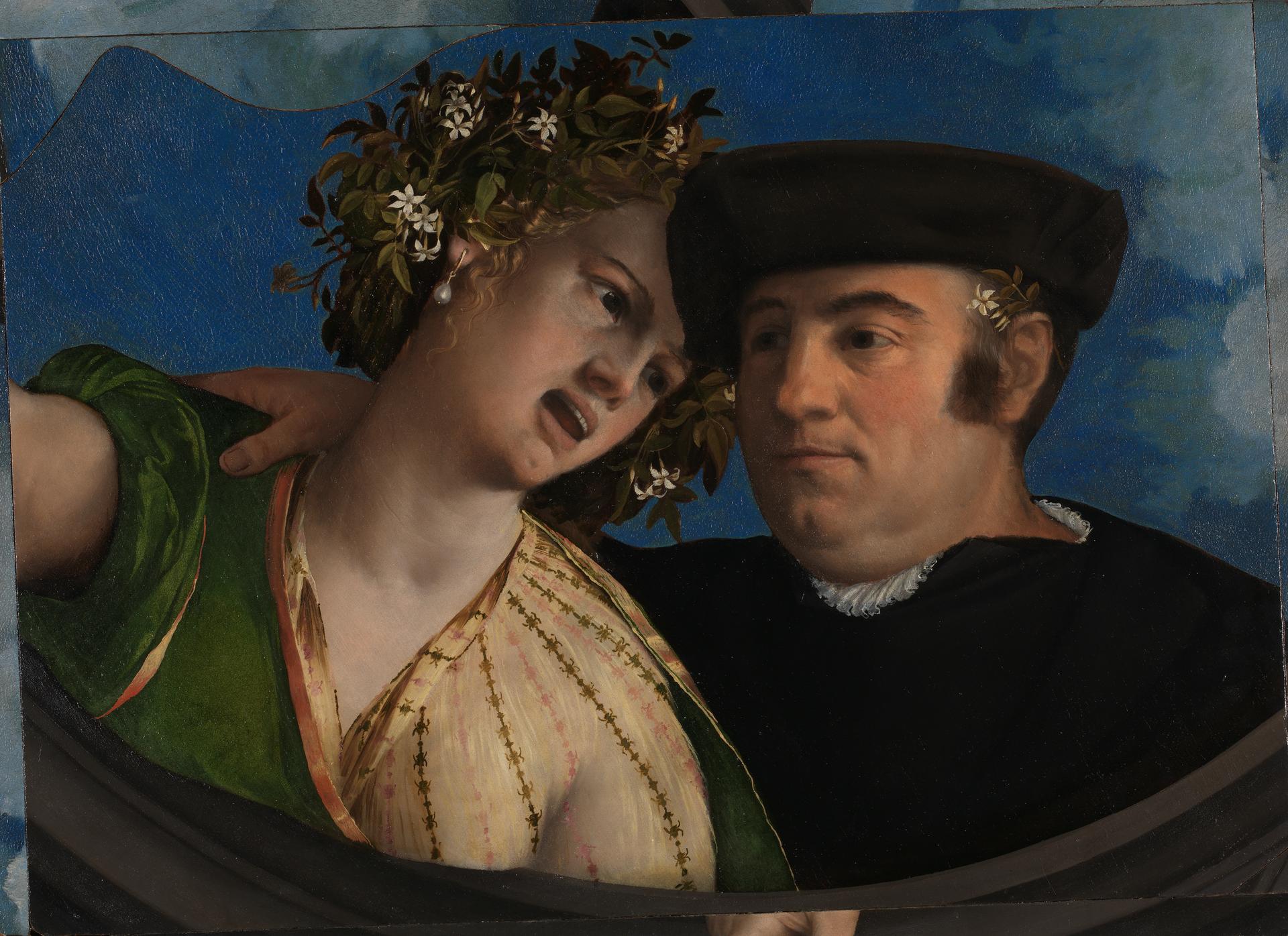
A Bacchanal

- Artist: Dosso Dossi
- Date: about 1525
- Medium: oil on canvas
- Museum: The National Gallery
- Collection record: The National Gallery website
Listen to the free audio guide
About this artwork
This is the "A Bacchanal" painted in the Italian north around 1525. You can see a lively scene of lovemaking and drunkenness involving nymphs and satyrs, followers of Bacchus, the Roman god of wine, agriculture and fertility.
The painting appears to show Silenus arriving uninvited at the Feast of the Gods, as described by Ovid in his book 'Fasti'. However, it's also possible that this is just a general scene of bacchanalia. Look closely at the man on the right, holding a glass of red wine - he catches your eye with a direct smile.
The woman beside him seems to be blowing a horn to wake up her companion who has allowed a flask of wine to spill. Behind them, a naked nymph is being comforted by a satyr, while in the distance you can see women listening to satyrs playing instruments.
It's worth noting that this painting resembles the great bacchanal scenes commissioned from Venetian painters for Alfonso I d'Este's palace, particularly Bellini's 'Feast of the Gods' and Titian's 'Bacchanal of the Andrians'. However, it lacks the pigment ultramarine blue, which is a distinctive feature of those paintings. The blue in this sky is azurite, but unfortunately, it's been covered by old varnish and overpainting.
Unfortunately, we don't know who exactly painted this picture, but it's likely to be an artist influenced by Dosso Dossi's work or someone trying to follow in his footsteps.
See it in person
A Bacchanal hangs in The National Gallery on Trafalgar Square, London — free to enter. Point your phone at any artwork there and audioguide.london plays a free audio guide in six languages — no app download needed.