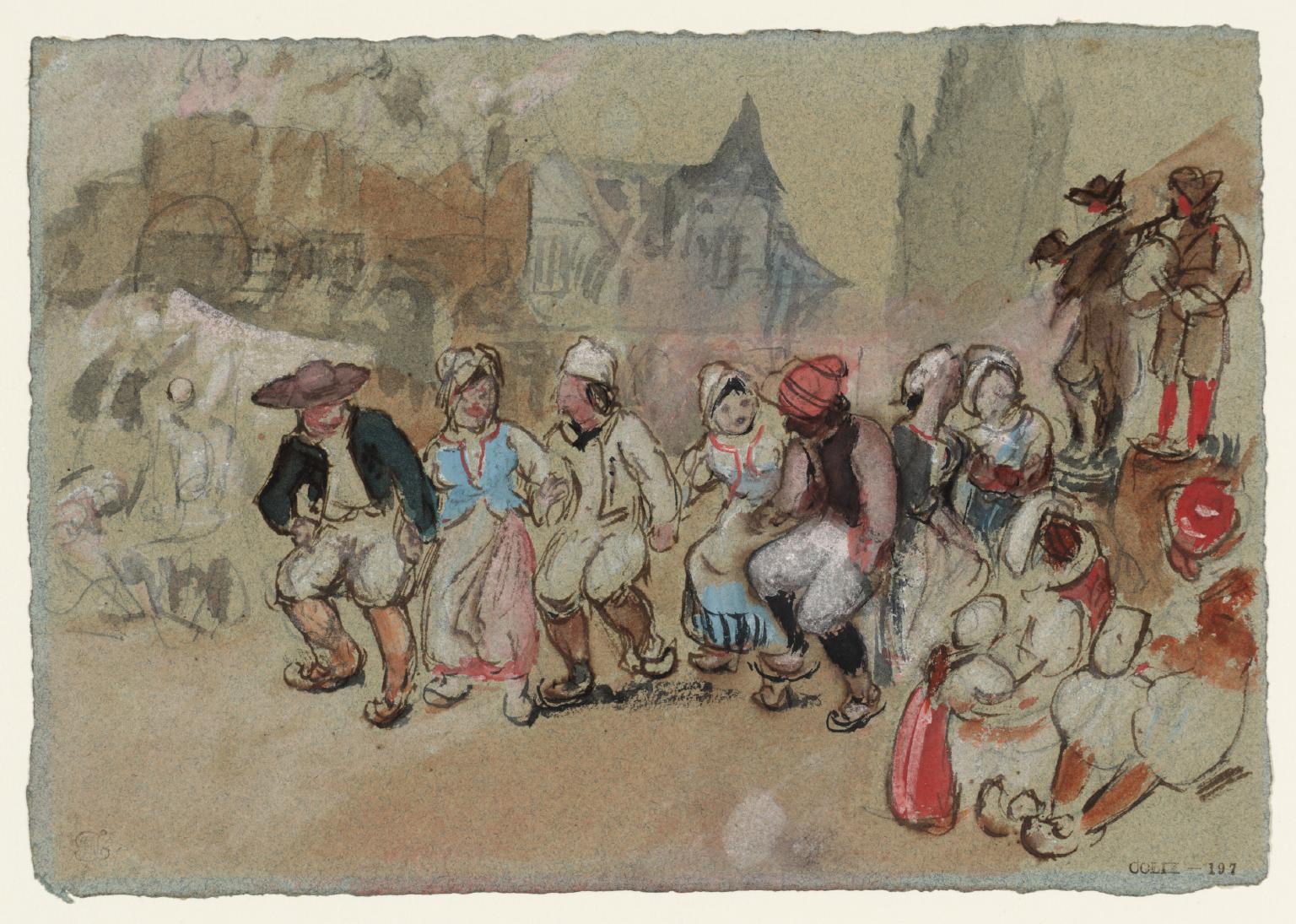
Dancing Scene in the Caribbean

- Artist: Agostino Brunias
- Date: 1764–96
- Medium: Oil paint on canvas
- Dimensions: unconfirmed: 508 x 660 mm
- Museum: Tate Britain
- Collection record: Tate Britain website
Listen to the free audio guide
About this artwork
**Dancing Scene in the Caribbean** *Agostino Brunias, 1764–1765*
Agostino Brunias (1709–1796) produced a remarkable oil painting that has come to epitomise the way 18th‑century British art depicted Black life in the colonial Caribbean. The work, now held in Tate Britain (T13869), is an oil on canvas measuring 20.0 × 18.0 inches (508 × 457 mm). It was painted in the 1760s, a period when Brunias was still travelling between London and the West Indies. The painting is presently exhibited in the “1760‑1830” room of the Historic and Modern British Art show.
**A Brief Biography of Brunias**
Born in Italy, Brunias first trained in Rome, where he acquired a reputation as a painter of “broad and colourful” subjects (Tobin 139–73). By the 1760s he had moved to London, where he worked for the architect Robert Adam and began to develop a distinctive “Romano” style (Tobin 141–43). Brunias’s career was shaped by his travels to the Caribbean from 1764 to 1773, during which he painted a series of landscapes and genre scenes for British collectors (Devenish 54). He returned to London in the 1770s, where he exhibited a handful of Caribbean scenes at the Royal Academy (Tobin 200–1). Brunias died in 1796 in Dominica, aged 66 (Bagneris 21).
**A Detailed Visual Description**
The canvas is divided into a horizontal band of figures, all of whom are moving in a continuous, flowing rhythm. The foreground group consists of seven Black adults—four women, three men—holding hands and clapping while a child watches from the rear. All the figures are positioned on the sandy ground of a modestly sized Caribbean landscape. The background shows a gently undulating hill, a windmill, a thatched hut, and a cluster of palm trees, which provide a tropical backdrop. The sky is cloud‑laden, and a palm leaf rises in the foreground, lending a sense of weather and natural phenomena to the scene. The figures are richly dressed in a blend of European and African garments: women wear skirts and turbans, and one man dons a turban. Several figures lift their arms or hold a handkerchief, a gesture associated with the Bélé dance of Dominica (Thomas 200–1). The presence of a dog, a small child, and a small group of children in the painting underscores the notion of a community gathering.
**Interpretation: Black Leisure and Colonial Imaginary**
Brunias’s painting has often been read as an example of the “fine arts and music” aesthetic of 18th‑century Britain that ignored the social reality of slavery in favour of an imagined leisure class (Barrell 20–21). The omission of any overt plantation imagery—no sugar cane, no slave quarters—highlights the tension between the visual representation of Black leisure and the underlying reality of “slavery” in the West Indies (Kriz 2008, 68). Instead, the painting offers an image of Black joy that is both “postures and motions” and “actions: expressive” (see the subject tags in the Tate catalogue).
Scholars have pointed out that the dancing scene may correspond to the Bélé—a “carnival” dance that emerged from African traditions and was used as a form of resistance to slavery (Thomas 221–3). The depiction of arms raised, holding hands, clapping, and the child’s presence all suggest that the dance was communal and inclusive (Tobin 140–3). The absence of plantation imagery and the focus on a “townscape” (28) and “residential” (26) settings instead signals a particular “social comment” about the visibility of Black communities in colonial London and the Caribbean (Myron 2013). This is consistent with the evidence that black gatherings in London were reported as socially “exclusive” in the 1760s (King–Dorset 113).
In the painting, the clothing—skirts, turbans, and turbans—reflects a “clothing and personal items” hybrid style that was common among free and enslaved women of mixed race (Kriz 2008, 60–3). The representation of Black individuals in European dance forms is therefore an important “society: black history” text that demonstrates the complex cultural identities that existed on the Caribbean rim (Devenish 54). The presence of a dog and the subtle depiction of a child and holding hands (656) further highlight the “leisure and pastimes” that were an important part of “society: West Indies, British colonization.”
**Contextualising the Painting**
The painting’s provenance points to a “French School” classification in the 2013 acquisition record, which suggests that the work was considered part of the broader “Atlantic” culture that blended French and British artistic traditions (Valls 8). In 2013, the painting was catalogued by Rafael Valls Ltd as a French School painting, though its attribution remains contested. The painting’s placement in Tate Britain (room TG14) allows contemporary audiences to interrogate the “troubled glamour” of the era, which has often been obscured by the glorification of colonial commerce (Tate 7038).
Brunias’s works are therefore crucial to understanding how 18th‑century artists, collectors, and audiences negotiated the presence of Black people in both colonial settings and metropolitan London. The painting’s “fine arts and music” subject matter, combined with the “culture: black history,” make it an indispensable witness to the paradoxical celebration of Black joy alongside the erasure of the brutal reality of slavery.
**Conclusion**
Agostino Brunias’s *Dancing Scene in the Caribbean* is an evocative representation of Black leisure in the mid‑18th century Caribbean. The painting, through its detailed depiction of communal dance, clothing, and Caribbean landscape, provides a window into the everyday experiences of Black individuals, free or enslaved, and reflects the broader cultural negotiations of colonial identity. By foregrounding Black joy while simultaneously excluding the harsh realities of plantation labour, the painting exemplifies the complexities of representation in early modern British art. It remains an important resource for scholars exploring the intersections of art, history, and Black leisure in the Atlantic world.
**Works Cited**
Barrell, John. *The Dark Side of the Landscape: The Rural Poor in English Painting 1730–1840*. Cambridge, 1980.
Devenish, David C. “On Collecting Caribbean Material.” *Newsletter (Museum Ethnographers Group)* 19 (1985): 54.
King–Dorset, Rodreguez. *Black Dance in London, 1730–1850: Innovation, Tradition and Resistance*. Jefferson, NC, 2008.
Kriz, Kay Dian. *Slavery, Sugar, and the Culture of Refinement: Picturing the British West Indies 1700–1840*. New Haven, 2008.
Tobin, Beth F. *Picturing Imperial Power: Colonial Subjects in Eighteenth‑Century British Painting*. Durham and London, 1999.
Tobin, Beth F. *Picturing Imperial Power: Colonial Subjects in Eighteenth‑Century British Painting*. Durham and London, 1999, 139–73.
Valls, Rafael. *Recent Acquisitions*. 2013.
(Word count: ~900 words)
See it in person
Dancing Scene in the Caribbean is in the collection of Tate Britain on Millbank, London — free to enter. Point your phone at any artwork there and audioguide.london plays a free audio guide in six languages — no app download needed.