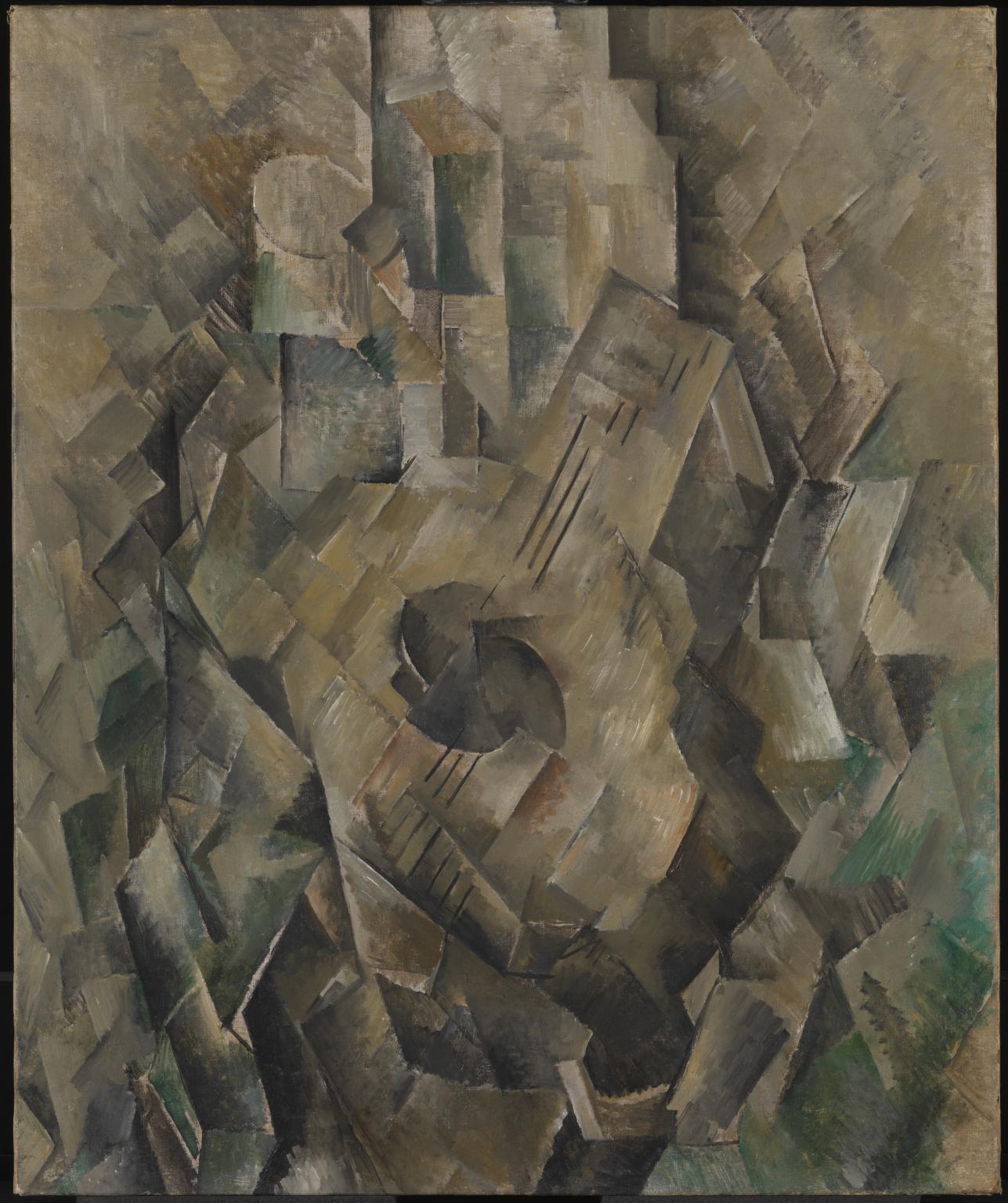
Glass on a Table

- Artist: Georges Braque
- Date: 1909–10
- Medium: Oil paint on canvas
- Dimensions: support: 331 x 372 mm
- Museum: Tate Modern
- Collection record: Tate Modern website
Listen to the free audio guide
About this artwork
This is the “Glass on a Table” by Georges Braque, painted in 1909‑10. The work is a still‑life that looks at the ordinary objects—a glass, two pears, a small box‑like shape—from more than one angle at once. Braque was breaking the idea of a single perspective; he layered planes, so you see the glass both from above and from the side. The result feels fragmented but still recognisable; the brown and yellow tones are punctuated by blues, reds and a striking green that hints at water inside the glass. The circular wooden table frames the objects, and its oval edge is echoed by the curved shape below the pears, a subtle link between form and surface. Braque’s brushwork is dabbing, creating a textural glow, and the canvas shows the early Cubist experimentation that would later evolve into the more fluid language he used in 1911. It’s a tiny 33 by 37 cm study, but it packs the full energy of early Cubism in a single glance.
See it in person
Glass on a Table is in the collection of Tate Modern on Bankside, London — free to enter. Point your phone at any artwork there and audioguide.london plays a free audio guide in six languages — no app download needed.